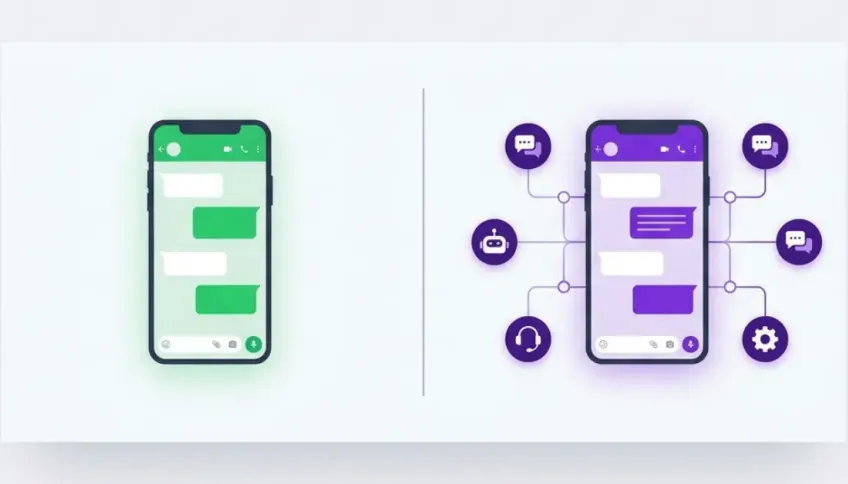
You started answering customers on WhatsApp from your own phone. It worked well: fast, direct, free. But the business grew, messages piled up, and now you’re replying late, conversations overlap, and sales slip through without you noticing. At some point you started hearing about “WhatsApp API” without quite understanding what it is, or whether your business actually needs it.
In this article you’ll learn the real difference between the app you’re already using and the API, what each one costs in 2026, and — most importantly — the exact moment your business should make the jump.
The three versions of WhatsApp for business (and which one you’re using)
There are three ways to use WhatsApp for a business, and it’s worth knowing which one you’re standing on before making any decision:
1. Regular WhatsApp (personal) — the green app you use with family and friends. It has zero business tools, and using it for professional customer service violates Meta’s terms of service, which can end in your number getting suspended.
2. WhatsApp Business (the free app) — the natural next step for any business getting started. It lets you set up a profile with hours, a catalog, welcome messages, and quick replies. It runs from one primary phone, with up to four linked devices. It’s great for small businesses and for validating that WhatsApp is a real sales channel for you.
3. WhatsApp Business API — this isn’t an app you download. It’s a technical, cloud-based connection that lets you integrate WhatsApp with other systems: your website, a CRM, an AI chatbot, multiple agents working at once. It has no interface of its own (you need software to manage it), but it removes the device and simultaneous-conversation limits entirely. This is what businesses handling real volume use.
The vast majority of small businesses sit in option 2 — and the rest of this article is about when and why it makes sense to move to option 3.
The real difference between the app and the API
| Feature | WhatsApp Business (app) | WhatsApp Business API |
|---|---|---|
| Cost | Free | Pay per message + platform (BSP) |
| Devices | 1 phone (+ up to 4 linked) | Unlimited — multiple simultaneous agents |
| Automation | Basic (quick replies) | Advanced: chatbots, AI, automated flows |
| Website/CRM integration | No | Yes — connects to your site and systems |
| Bulk messaging | Very limited | Yes, with Meta-approved templates |
| Simultaneous service | One agent at a time | Multiple agents and bots at once |
| Best for | Small businesses | Growing or high-volume businesses |
The part that hurts most in practice is “simultaneous service.” If you have two or three reps trying to handle the same number from linked web sessions, sooner or later conversations overlap: nobody knows who already replied to whom, one customer gets left on read, and another gets the same question twice. The API fixes this at the root, because multiple agents — human or bots — work on the same number in an organized way, each with their own session.
How much does WhatsApp Business API cost in 2026?
Here’s an important point that changed and that a lot of people still don’t know: since July 2025, WhatsApp charges per message, not per conversation.
Previously, a single rate covered all messages within a 24-hour window. Now every template message you send has an individual cost, depending on the message category and the recipient’s country.
Message categories and their cost:
- Service (replies to customers): when a customer messages you first, a 24-hour window opens. Replying within that window is free. This is the most common category for customer service, and the one worth designing your flows around.
- Utility (confirmations, shipping): transactional messages like payment or delivery notices. Low cost.
- Authentication (codes, verification): one-time codes and identity checks. Low cost.
- Marketing (campaigns, promotions): the most expensive category, since it’s initiated by the business, not the customer.
On top of what Meta charges, you also need to pay your provider (BSP, Business Solution Provider) — the platform you use to manage your chats. Some charge a fixed monthly fee, others add a per-message surcharge. Without a BSP you can’t use the API at all; it’s a required piece of the setup, not an optional add-on.
One detail that changes the math for a lot of small businesses: Meta gives every account 1,000 free service conversations per month. If your business mostly replies to customers who message you first, your real cost with Meta can end up close to zero, on top of just the BSP’s fee.
⚠️ Important: Meta adjusts its rates periodically, and they vary by recipient country. Exact costs should be verified at the time of implementation. The key lever you can design in your favor: get the customer to message first — that way you reply for free within the 24-hour window.
When should your business upgrade to the API?
Not every business needs the API. A local shop processing a handful of orders a day can keep running fine on the free app. But these signals mean it’s time to seriously evaluate it:
-
You get more messages than you can answer on time. If you’re losing sales because you reply fifteen or twenty minutes after the customer wrote, automation pays for itself.
-
You need more than one person handling the same number. The regular app doesn’t let a team work the same WhatsApp number in an organized way without stepping on each other. The API does.
-
You want to automate frequent replies. If most of your messages are the same questions — price, hours, location, payment methods — a bot can answer them instantly, 24 hours a day.
-
You want to connect WhatsApp to your website or sales system. For example, so that when someone buys from your store, they automatically get an order confirmation on WhatsApp, with nobody having to type it by hand.
-
You’re spending on ads but leads go cold before anyone follows up. If your Meta Ads campaigns drive traffic to WhatsApp and the volume overwhelms your team, you’re burning budget on leads nobody qualifies in time.
If two or more of these sound like you, it’s time to take the API seriously.
The real leap: WhatsApp API + Artificial Intelligence
The API alone gives you the technical capability: it removes the device limit and gets your team organized. But the real competitive leap happens when you add artificial intelligence on top of it.
An AI sales agent connected to your WhatsApp API can:
- Reply to your customers instantly, 24/7, even while you’re asleep.
- Answer frequently asked questions without you having to step in.
- Qualify prospects: tell who’s ready to buy from who’s just browsing.
- Hand the customer off to a human only when it’s actually needed, with the full conversation context.
- Keep your business’s tone and information consistent, message after message.
Unlike a rigid button-menu chatbot (“type 1 for sales, 2 for support”), an AI agent understands natural language: the customer writes however they normally would, and the agent grasps the real intent behind the message. The result is that you stop losing sales to slow replies, you free up your own time and your team’s, and you deliver service that feels like a much bigger company even if you’re a small one.
At Web Booster, this is exactly what we offer: AI sales agents connected to WhatsApp Business API, trained on your catalog, your tone, and your most common objections.
The free WhatsApp Business app is perfect for getting started. But as your business grows, manual customer service turns into a bottleneck that costs you sales — and the fix isn’t hiring more people to do the same thing more slowly, it’s automating the repetitive part so your team can focus on closing.
At Web Booster we help you make the jump: we connect WhatsApp Business API with an AI sales agent that handles, replies to, and qualifies your customers automatically, so no sale slips away because someone replied too late.
👉 Ask us via WhatsApp: Let’s talk here