You love the idea of a site that loads in under a second. You have seen the numbers: a fast site keeps visitors, lowers bounce rate, gets more out of your ad spend, and climbs on Google. But right when you are about to decide, the doubt that freezes the project shows up: “If I move to a blazing-fast site, how do I manage it? Will I depend on the agency every time I want to change a price or upload a photo? Will it connect to the sales WhatsApp and the CRM I already use?”
That fear is legitimate, and it stalls more deals than you would think. The good news: you no longer have to choose between speed and control. You can have a site that flies and still manage it yourself from the WordPress you already know. This article explains exactly how — no jargon.
Straight answer: yes, it can be done. It works by separating two things that used to be glued together: where you manage the content (your usual WordPress, in the back) and what the visitor receives (an ultra-light, pre-built page). You manage it just like today; your customers get a much faster site.
The false dilemma: speed OR control (spoiler: you can have both)
For years it seemed you had to pick one of two paths, each with a painful cost:
- Traditional WordPress: easy to manage yourself, adopted by millions of businesses. But as you pile on plugins, pixels, and features, it gets heavy and slow — and that hurts the experience and your SEO.
- Custom-built fast site: it flies and delivers unbeatable metrics, but it seemed to doom you to depending on a developer just to change a phone number.
That dilemma no longer exists. Web engineering evolved, and today you can build a setup where the visitor receives a page that responds in under a second, while your team keeps managing the information from the same panel as always. The trick is an architecture that intelligently separates the internal environment where information goes in from the public interface the customer sees.
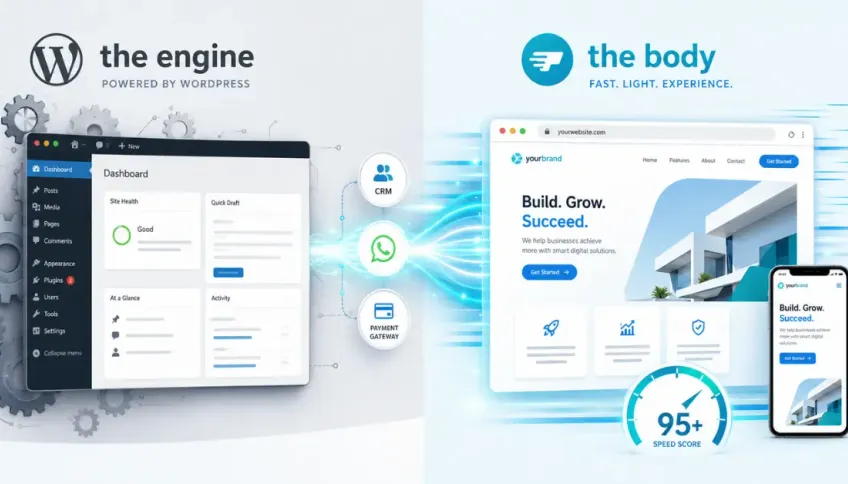
How it works: the engine and the body
To understand this without jargon, think of a car. It has an engine (what makes it run) and a body (what you see and touch). In a traditional website, the engine and the body are the same welded piece. That is why, every time a visitor arrives, the server has to “start the whole engine” — query the database, run code, assemble the page in that millisecond — before showing you anything. That effort, repeated on every single visit, is what makes the site slow.
Modern architecture separates the two pieces:
- The “engine” (WordPress): stays as your usual admin panel. That is where you go to write, change prices, upload photos, publish products. Same block editor, same SEO plugins, same user roles. Your workflow does not change at all.
- The “body” (what your customer sees): is built separately with our high-performance technology — the Motor Performance WB — which takes the information from your WordPress and turns it, ahead of time, into an ultra-light, clean page with no unnecessary processes, ready to be served instantly.
| Component | What technology it is | How your company experiences it |
|---|---|---|
| The Engine (internal management) | Your usual WordPress | Your team edits and publishes from the same panel, with full autonomy |
| The Body (the public side) | Motor Performance WB | The visitor gets a pre-built site that loads almost instantly on any device |
This is what dissolves the fear: your team logs into the WordPress panel at the same URL as always, finds the same users and the same sections, and manages it just like yesterday. Management does not notice that the technology changed underneath. The only thing they notice is that the site now flies.
In one line: you manage your content in the WordPress you already know, but your customers receive a blazing-fast site. The control is yours; the speed is ours.
Technical section (for those who want the detail)
Note: if your role is management, sales, or marketing, you can skip straight to the next section without missing anything. This is for systems profiles.
This architecture is known as “headless” or decoupled. WordPress stops rendering the public-facing design and works purely as a content manager (backend), securely exposing the information through its API (REST or GraphQL). The layer the user sees — the frontend — is built separately with static site generation (SSG): every page, landing, or article is pre-compiled into flat files of HTML, optimized CSS, and minimal JavaScript, distributed from a global edge network (CDN).
The infrastructure result is decisive: no PHP running on every visit, no MySQL queries per page, minimal TTFB, full resilience against traffic spikes, and comfortable compliance with Google’s Core Web Vitals. Our Motor Performance WB implements exactly this model, which is why the sites we build aim for PageSpeed >95 and sub-second loads.
The 4 business advantages of connecting your fast site to WordPress and your systems
1. You manage everything yourself, depending on no one
You change prices, add products, publish blog articles, update photos and galleries — all from the WordPress panel you already know how to use. No tickets to open, no emails asking for minor changes, no maintenance fee for editing a line of text. Control over your content stays in your company.
2. It connects to the tools you already use
A website cannot live isolated from the rest of your operation. With this technology it is simple to integrate the site with your business systems: forms deliver every contact straight to your CRM so no lead goes cold, and the site links to WhatsApp, payment gateways, inventory, or email automation. Your site stops being a passive brochure and becomes a piece of your commercial engine.
3. Far more secure
This advantage is rarely mentioned. The vast majority of WordPress attacks come through two doors: outdated plugins and exposed forms that run commands against the database. In a decoupled architecture, your WordPress panel lives in private, out of the public’s reach, and what the visitor sees is only static files that execute no server-side code. The attack surface drops to nearly zero: no exposed database, no exploitable plugins facing the public. There is nothing to hack on a static page.
4. It handles any traffic spike
On traditional hosting, a sudden surge — a big campaign, a media mention, peak season — saturates the server and takes the site down at the worst possible moment. With the Motor Performance WB, since pages are already pre-built and distributed globally, the server does not compute anything per visitor. It makes no difference whether 10 people or 10,000 arrive at once: speed and stability hold. Your site does not crash when you need it most — and you protect every dollar spent on ads.
Which type of business does this make sense for?
Honestly, because not everyone needs the same thing. This architecture shines especially if:
- Your site is mostly content: corporate, services, catalog, blog, or landing pages.
- You care about mobile load speed and Google ranking.
- You want to connect your site to your CRM, WhatsApp, or other systems.
- You handle or expect traffic spikes from campaigns or seasons.
- You value security and want to cut the risk of hacks and malware-cleanup costs.
And when might a traditional WordPress be enough? If your site is very small, low traffic, with no growth or SEO goals, and relies 100% on a very specific visual builder for layout, this architecture may not be your priority today. Saying so is part of advising well. If you suspect your current problem is speed, start by understanding why your website is so slow.
What the process looks like with Web Booster
It does not have to be a chaotic project. At Web Booster we do it in five clear steps:
- We analyze your case. What you need to manage, which systems you want to connect (CRM, WhatsApp, payments), and what visibility and conversion goals you are chasing.
- We build your site with the Motor Performance WB — blazing fast, optimized for Google, and ready to be cited by AI engines.
- We connect your WordPress panel in the back, set up so you manage everything yourself with ease, with your usual roles and plugins.
- We integrate your tools: we wire forms to your CRM, enable WhatsApp, connect payment gateways, and any API your business needs.
- We hand it over and train you. We show you how simple it is to manage the content. If you already used WordPress, there is nothing new to learn.
You no longer have to choose between a fast site and a site you can control. With the right architecture you get both: the speed that ranks and converts, and full control from the tools your team already masters.
At Web Booster we build your Portal Web Performance connected to WordPress and to your business systems — so your site is fast, yours, and part of your operation.
👉 Discover the Portal Web Performance: /en/portal-web-performance
👉 Tell us what you need to connect: Message us on WhatsApp